
20 June 2026
FUE Hair Transplant: What the Procedure Actually Involves
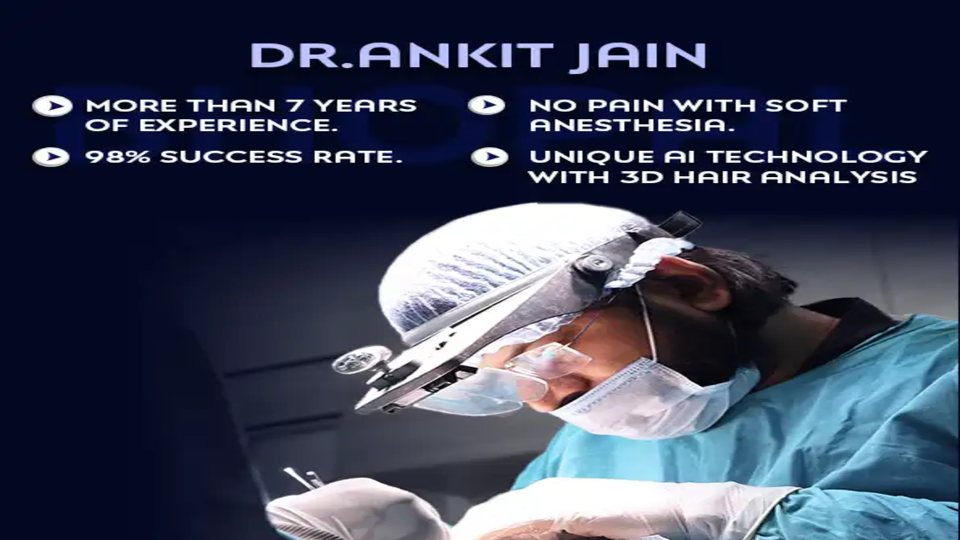
FUE (Follicular Unit Extraction) is one of the more commonly discussed hair transplant techniques, but patients researching it often only encounter before/after marketing rather than a clear explanation of what actually happens during the procedure. Here’s a step-by-step overview.
1. Consultation and Assessment
Before anything else, Dr. Jain examines the donor area (usually the back and sides of the scalp) and the extent of hair loss to determine whether FUE is appropriate, and roughly how many grafts a case is likely to need. Not every case of hair loss is suited to a transplant at all — this is assessed honestly, not assumed.
2. Donor Area Preparation
The donor area is trimmed and prepared, and local anaesthesia is administered so the area is numb for the remainder of the procedure.
3. Graft Extraction
Individual hair follicles (follicular units, usually containing 1-4 hairs) are extracted one at a time from the donor area using a fine punch tool, rather than removing a strip of scalp (as in the older FUT technique). This is the step that gives FUE its name.
4. Recipient Site Creation
Tiny incisions are made in the recipient area (where hair is thinning or absent), with careful attention to angle and direction so the transplanted hair grows in a natural-looking pattern.
5. Graft Placement
The extracted follicles are placed into the recipient sites one by one. This step is time-intensive and is a large part of why FUE sessions can take several hours depending on the number of grafts.
6. Aftercare
Post-procedure instructions cover how to clean the scalp, when normal activity (including exercise) can resume, and what temporary effects — redness, scabbing, mild swelling — are normal in the first one to two weeks.
What This Doesn’t Tell You
A written overview can explain the steps, but it can’t tell you whether FUE is right for your specific case — that depends on donor density, the pattern of your hair loss, and health factors that only come up in an in-person consultation.
This article is for general educational purposes and is not a substitute for an in-person medical consultation. Individual results vary.
Written by Prisha Skin & Hair Clinic Team
Medically reviewed by Dr. Ankit Jain, MBBS, D.V.D (MP11998)